


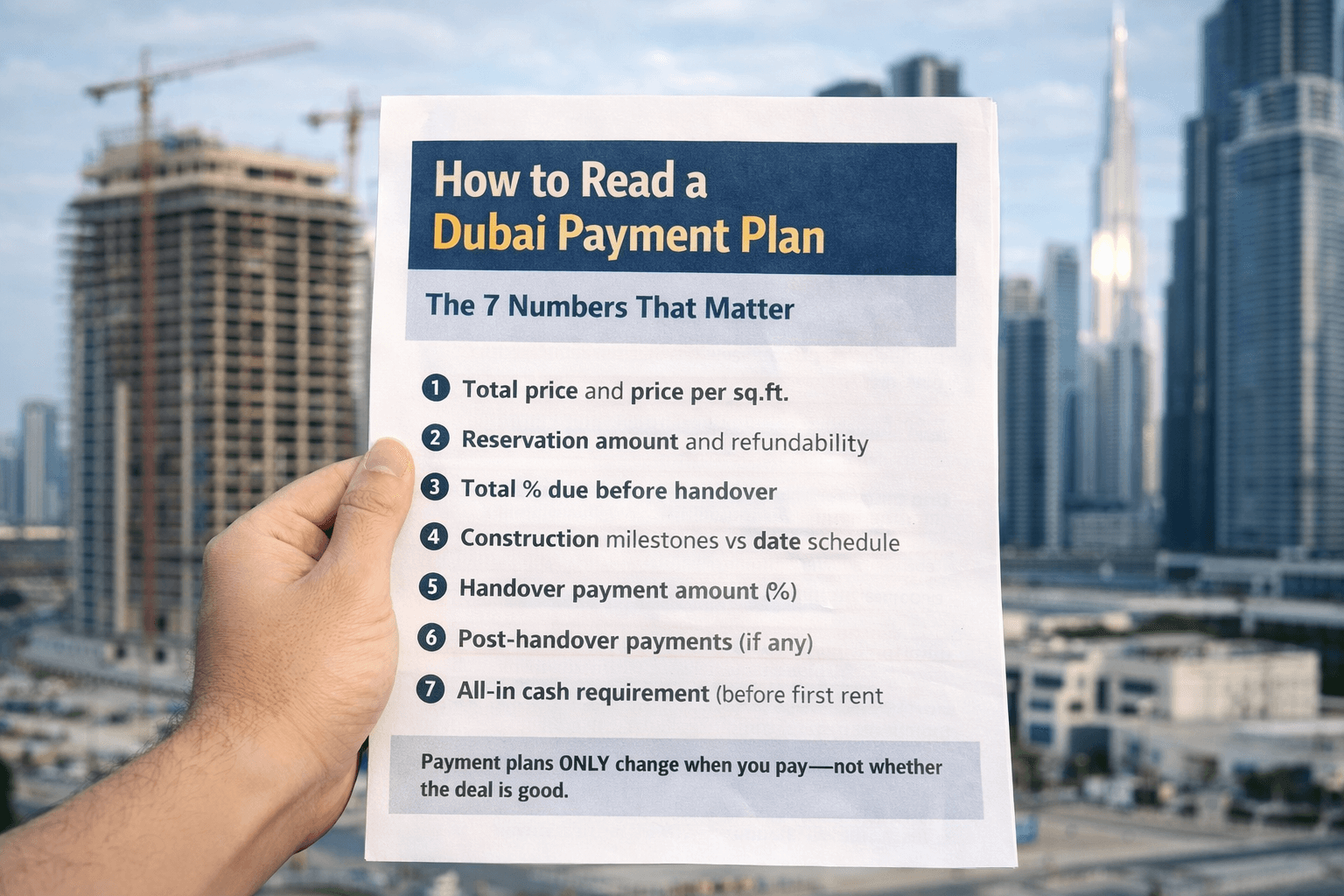
How to Read a Dubai Payment Plan: The 7 Numbers That Matter
Dubai off-plan payment plans are often marketed as if the plan itself is the investment. It isn’t. A payment plan only changes when you pay, not whether the deal is good. If you’re buying from abroad, reading the plan correctly is one of the fastest ways to avoid overpriced units, cash-pressure surprises, and weak exits. Use the framework below: the 7 numbers that matter, why each matters, and what should stop you from reserving.
- The Trading Immo Rule
- What a Payment Plan Actually Tells You
- The 7 Numbers That Matter (Investor Checklist)
- 1) Total Price (AED) and Price per sq.ft.
- 2) Reservation Amount (AED) + Refundability
- 3) Total % Due Before Handover
- 4) Milestone-Based vs Date-Based Schedule
- 5) Handover Payment (AED / %)
- 6) Post-Handover Payments (If Any)
- 7) All-In Cash Requirement Before First Rent
- The Three Biggest Payment Plan Traps
- A Simple Fast Rating (3 Questions)
- What to Check Next (So You Don’t Over-Focus on the Plan)
- Final Takeaway
The Trading Immo Rule
A strong payment plan cannot fix weak fundamentals. Location, pricing, unit liquidity, service charges, and exit conditions decide performance. The plan is only a cash-flow tool layered on top of those fundamentals.
What a Payment Plan Actually Tells You
A payment plan tells you: the reservation amount, the down payment, the installment schedule, what is due at handover, and sometimes what is due after handover. It does not tell you: if the price is fair, if the unit will rent quickly, if service charges will destroy net yield, or if you will be able to resell in a slower market. That’s why you must read the plan as one part of a broader investment decision.
The 7 Numbers That Matter (Investor Checklist)
1) Total Price (AED) and Price per sq.ft.
Start with the total unit price and the built-up area (BUA). Convert it into price per sq.ft. so you can benchmark properly. If you can’t justify the premium versus comparable resale or nearby launches with real reasons (view, scarcity, proven demand, superior quality), the plan is irrelevant because the entry price is wrong.
2) Reservation Amount (AED) + Refundability
Reservation is the moment you lose leverage. Confirm the exact amount, whether it is refundable, and the deadline to sign the SPA after reserving. If the forfeiture conditions are unclear, or if you’re told to pay before receiving key documents, treat it as a red flag. A non-refundable reservation is not “a small step”; it’s a commitment.
3) Total % Due Before Handover
This is the most important number in most off-plan deals. It defines how much capital you will deploy before the unit produces any income. A 70/30 plan (70% before handover) locks far more capital than a 50/50 plan, and increases your exposure if the market slows before completion. The higher the pre-handover percentage, the more disciplined you must be on pricing and fundamentals.
4) Milestone-Based vs Date-Based Schedule
Identify whether payments are triggered by construction milestones or fixed dates. Date-based schedules can force cash outflow even when progress is slow. Milestone-based schedules are safer only if milestones are clearly defined and tied to verifiable progress. If milestone definitions are vague, or the schedule is unusually aggressive for the stated delivery timeline, you are taking more timeline risk than you think.
5) Handover Payment (AED / %)
Many buyers underestimate the handover moment. Confirm the exact percentage due at handover and anticipate additional practical costs around handover (utilities setup, snagging, initial service charge buffers, potential admin items). If you’re planning to resell at handover, this is your biggest pressure point. If you can’t comfortably cover the handover amount, you don’t have a strategy; you have a hope.
6) Post-Handover Payments (If Any)
Post-handover plans can be useful, but only if the unit can rent immediately at realistic rates and the net cashflow can cover the installments. Verify the post-handover duration, payment frequency, and the amount due each period. Also remember: service charges start at handover, whether the unit is rented or not. If the plan is sold with “the rent will pay the installments,” demand a net model that includes service charges, management, maintenance, and vacancy.
7) All-In Cash Requirement Before First Rent
This is the number most buyers fail to calculate. Your real cash requirement includes: reservation + down payment, all pre-handover installments, the handover payment, registration/admin fees, furnishing and setup (if applicable), initial service charges buffer, and a vacancy buffer. If you cannot cover the all-in requirement comfortably, the plan does not fit you, even if it looks “light” month-to-month.
The Three Biggest Payment Plan Traps
First, the “small monthly payments” illusion: a plan can feel easy while still requiring a large total commitment before handover. Second, hidden balloon payments: one big installment at a milestone or at handover can break your liquidity. Third, “rent will pay the post-handover plan”: rent is rarely pure profit once you include service charges, vacancy, management, and maintenance.
A Simple Fast Rating (3 Questions)
Use this quick filter before reserving: (1) Does this plan create high cash pressure before handover? (2) Am I highly exposed to timeline and market-cycle risk? (3) Is post-handover cashflow realistic on a net basis? If two answers are “yes,” pause and re-check pricing, liquidity, and fundamentals.
What to Check Next (So You Don’t Over-Focus on the Plan)
After reading the plan, validate: pricing vs comparables, service charge estimate, unit liquidity (rent and resale), developer delivery record, and the SPA clauses that matter (handover definitions, variation clauses, default terms). A good plan attached to a weak asset is still a weak investment.
Final Takeaway
A payment plan is not the deal; it’s the payment schedule for the deal. The best payment plan is the one that matches your strategy, liquidity, and risk tolerance—after you’ve validated the fundamentals, pricing, and exit options. If any of the 7 numbers is unclear, do not reserve quickly. Clarify first.
