


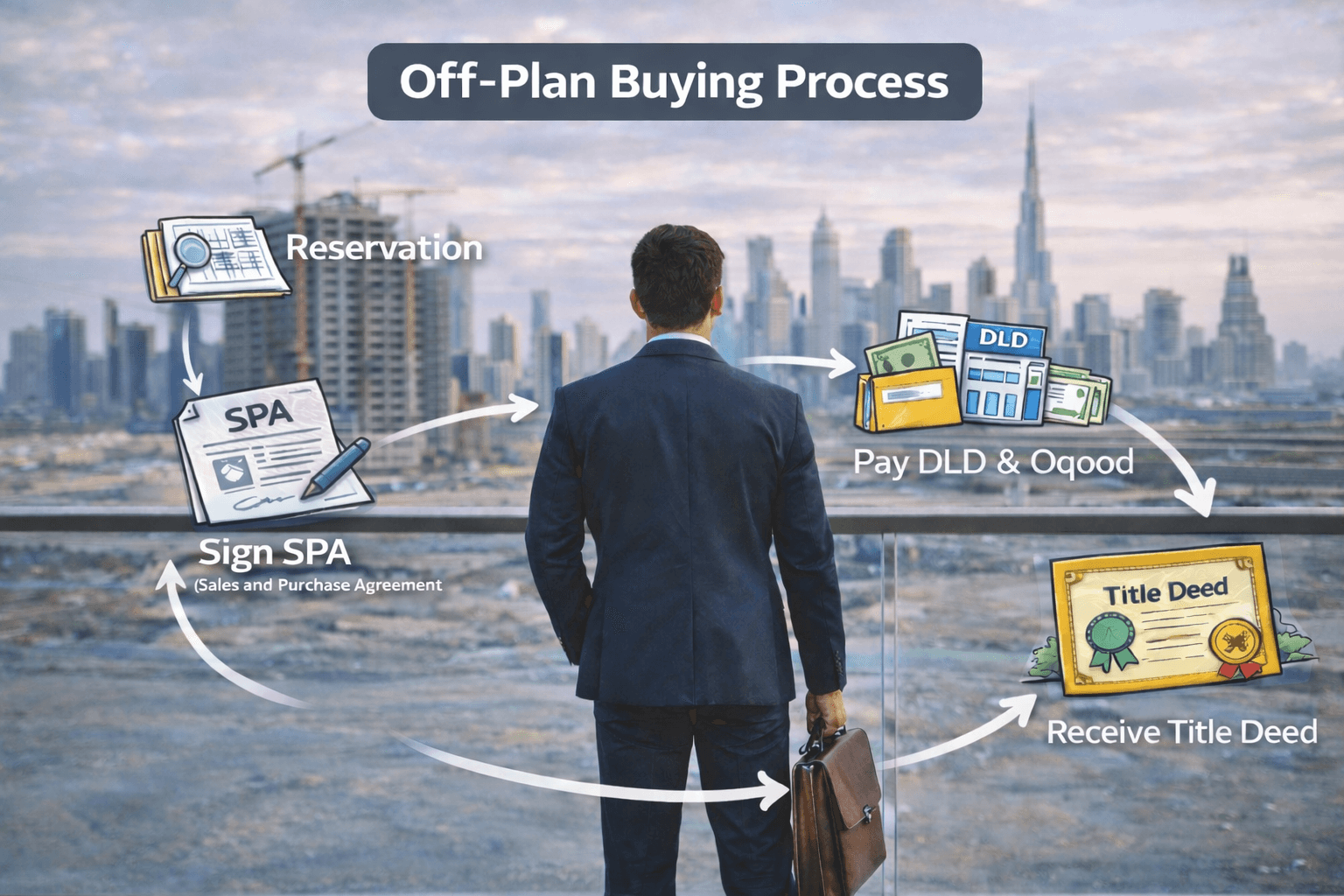
Dubai off-plan can feel fast and confusing—especially for non-resident buyers. Brokers talk about “reservation,” developers mention “SPA,” someone asks you to pay “DLD,” and then you hear “Oqood” without a clear explanation of what it actually is.
- Quick Definitions (So You Stop Guessing)
- The Off-Plan Buying Process (Step-by-Step)
- Step 1: Choose the unit and confirm the full offer
- Step 2: Pay the reservation fee (only after you understand terms)
- Step 3: Submit KYC documents (buyer verification)
- Step 4: Sign the SPA (Sales and Purchase Agreement)
- Step 5: Pay the DLD-related fees (registration costs)
- Step 6: Oqood registration (off-plan registration record)
- Step 7: Pay installments during construction
- Step 8: Handover notice and snagging process
- Step 9: Final payments, handover, and key collection
- Step 10: Title deed issuance (final ownership)
- Where Investors Lose Money (The Real Mistakes)
- Practical Checklist Before You Reserve
- FAQ (Quick and Simple)
- Is Oqood the title deed?
- When do I pay DLD in off-plan?
- What happens if I miss an installment?
- Can I resell before handover?
- Final Takeaway
This article breaks the process down into a simple, practical flow. You’ll understand what Oqood, SPA, and DLD mean, when they happen, what you pay, what documents matter, and where investors make the biggest mistakes.
Quick Definitions (So You Stop Guessing)
DLD (Dubai Land Department)
The government authority responsible for property registration and title deeds in Dubai. When people say “pay DLD,” they usually mean paying the registration fees and completing official registration steps.
SPA (Sales and Purchase Agreement)
Your main purchase contract with the developer. It defines the unit details, payment schedule, handover terms, and your obligations.
Oqood
Oqood is the off-plan property registration system/registration step used for properties under construction. It’s essentially an interim registration that records the off-plan sale under the buyer’s name before the final title deed is issued at completion.
Simple summary:
SPA = contract. Oqood = off-plan registration record. Title deed = final ownership at completion.
The Off-Plan Buying Process (Step-by-Step)
Step 1: Choose the unit and confirm the full offer
Before you pay anything, confirm in writing:
-
unit number, tower, floor, view, layout
-
total price, BUA, and payment plan
-
what’s included (parking, appliances, furnishing status)
-
any incentives (waived fees, furniture packages, etc.)
Investor rule: don’t reserve without tower plan / stack clarity.
Step 2: Pay the reservation fee (only after you understand terms)
The reservation fee is typically used to “hold” the unit. Before paying, confirm:
-
refundability (refundable vs non-refundable)
-
deadline to sign the SPA
-
what triggers forfeiture
Red flag: “Pay now, we’ll send documents later.”
Step 3: Submit KYC documents (buyer verification)
Developers typically request:
-
passport copy
-
proof of address
-
sometimes source of funds / additional compliance items
-
buyer details (especially if purchasing under a company)
Non-resident note: ensure your name details match passport exactly to avoid admin issues later.
Step 4: Sign the SPA (Sales and Purchase Agreement)
This is the most important legal step early on. The SPA should clearly state:
-
unit details and specifications
-
payment plan schedule and due dates/milestones
-
handover timeline definition
-
default clauses (late payment consequences)
-
variation clauses (what can change: layout/specs)
-
cancellation terms and penalties
Trading Immo rule: If you don’t understand the clauses that matter, don’t proceed on speed. Get clarity first.
Step 5: Pay the DLD-related fees (registration costs)
In off-plan, “DLD payment” usually refers to:
-
DLD registration fee (commonly referenced as 4% in many transactions)
-
admin fees depending on the developer/project structure
-
Oqood registration-related costs (project-specific)
Important: exact structure and timing vary by project and developer. Always request a written fee breakdown.
Step 6: Oqood registration (off-plan registration record)
After SPA signing and relevant payments, the transaction is recorded under Oqood. This is your key proof that:
-
the sale is registered as an off-plan transaction
-
the unit is linked to you as the buyer (interim record)
Why it matters:
-
it adds an official layer of registration before completion
-
it supports later processes like assignment/resale (subject to rules)
-
it reduces ambiguity about who the unit is sold to
Investor note: Oqood is not the final title deed. It’s an interim registration step.
Step 7: Pay installments during construction
You follow the payment plan schedule stated in the SPA. These installments may be:
-
milestone-based (construction progress)
-
date-based (calendar schedule)
Be disciplined:
-
set reminders
-
confirm receipts
-
maintain records for every payment
Late payments can trigger penalties and default clauses.
Step 8: Handover notice and snagging process
As completion approaches, you typically receive:
-
handover notices
-
final statements
-
instructions for inspection and snagging
Snagging is the inspection process to identify defects. Don’t skip it. Quality issues can affect rental speed and resale perception.
Step 9: Final payments, handover, and key collection
At handover, you typically:
-
pay any remaining balance due at handover
-
settle final admin/connection items
-
receive keys and handover documentation
From this moment, running costs begin (service charges, utilities), whether you rent immediately or not.
Step 10: Title deed issuance (final ownership)
Once the project is completed and the unit is fully transferred, you receive the final title deed. This is the definitive ownership document.
Simple summary:
Off-plan transaction recorded via Oqood during construction → Title deed issued after completion and transfer.
Where Investors Lose Money (The Real Mistakes)
Most losses don’t come from “paperwork.” They come from:
-
reserving without benchmarking price vs comparables
-
buying illiquid unit types in oversupplied micro-markets
-
ignoring service charges and net yield reality
-
relying on payment plans instead of fundamentals
-
signing an SPA without understanding key clauses
Practical Checklist Before You Reserve
Before any reservation fee, confirm:
-
price per sq.ft. benchmarked vs resale + nearby launches
-
your unit type is liquid (rent + resale)
-
a realistic estimate of service charges
-
a clear fee breakdown (DLD/admin/Oqood related)
-
SPA red-flag clauses reviewed (handover timeline, variations, default)
If one is unclear, don’t reserve quickly.
FAQ (Quick and Simple)
Is Oqood the title deed?
No. Oqood is interim off-plan registration. The title deed is issued after completion and final transfer.
When do I pay DLD in off-plan?
Timing varies by project and developer structure. Always request a written fee schedule. Do not assume the timing without confirmation.
What happens if I miss an installment?
Your SPA defines penalties and default terms. Late payments can cause fees, contract issues, and in extreme cases contract termination.
Can I resell before handover?
Sometimes, subject to developer rules, fees, and market liquidity. Check assignment/resale conditions in the SPA and with the developer.
Final Takeaway
Oqood, SPA, and DLD sound complex, but the logic is simple:
-
Reserve the unit only after you’ve benchmarked pricing and clarified terms.
-
Sign the SPA to lock the contract and obligations.
-
Register off-plan via Oqood during construction.
-
Receive the title deed after completion and final transfer.
If you treat off-plan like a structured process—not a launch event—you dramatically reduce surprises.
