


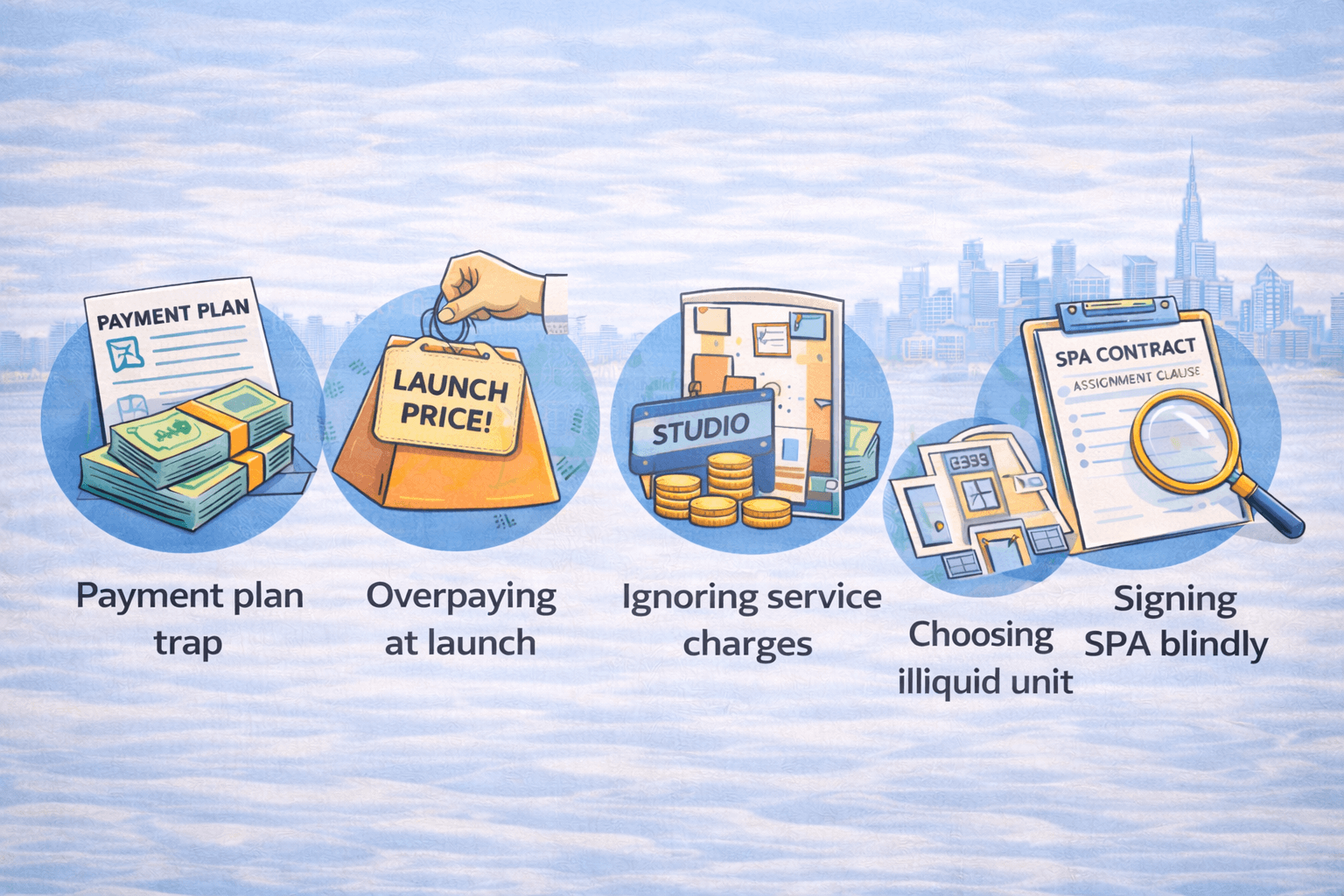
Below are the five most common mistakes non-resident buyers make when purchasing off-plan in Dubai. Each one is avoidable with a disciplined, investor-style process.
Mistake 1: Buying the Payment Plan Instead of the Deal
Foreign buyers often anchor on the monthly installments: “This is easy to afford.” But affordability is not profitability. A payment plan only changes timing. It does not fix weak location fundamentals, inflated pricing, poor unit liquidity (rent and resale), or high service charges that crush net returns.
How to avoid it: benchmark price per sq.ft. versus resale and nearby launches, model conservative net cashflow at handover, and treat the payment plan as a tool—not the reason to buy.
Investor rule: if the deal only looks good because of the payment plan, it’s probably overpriced.
Mistake 2: Overpaying at Launch Because “Launch Price” Sounds Like a Discount
Launch urgency is designed to create speed. Many buyers reserve before benchmarking because they fear missing out. The result: paying premium pricing disguised as “early-bird.”
How to avoid it: convert to price per sq.ft. and compare against three buckets: (1) nearby resale (ready) comparables, (2) competing off-plan projects with similar delivery timelines, and (3) a substitute area with proven demand. Check whether incentives (waived fees, post-handover plan) are hiding inflated pricing. Run a quick stress test (rent -10%, vacancy +1–2 months, charges +15%).
Investor rule: if you can’t justify the price without the marketing story, don’t reserve.
Mistake 3: Ignoring Service Charges (The Net Yield Killer)
Foreign buyers commonly evaluate gross rent and ignore service charges until after handover. That’s how “great ROI” becomes disappointing net performance. Service charges matter because they reduce net cashflow every year, impact rental competitiveness, and reduce resale liquidity if charges are high relative to rent.
How to avoid it: request a service charge estimate or compare to similar delivered buildings, evaluate net yield (not gross), and include management, maintenance reserve, and vacancy in your model.
Investor rule: you are buying building economics, not just a unit.
Mistake 4: Choosing the Wrong Unit Type (Low Liquidity Stock)
Many foreign buyers choose the cheapest unit or the smallest size because it feels “safe.” But in many micro-markets, certain unit types become oversupplied and illiquid—especially studios in heavy-launch communities. Liquidity matters in two ways: rental liquidity (how fast it rents at a fair price) and resale liquidity (how easy it sells in a slower cycle).
How to avoid it: identify which unit types rent fastest in that area (often 1BR, but it depends), prioritize efficient layouts and strong stacks/views, and avoid awkward layouts and purely marketing-driven designs.
Investor rule: a slightly higher price on a liquid unit is often safer than a cheaper price on an illiquid unit.
Mistake 5: Signing the SPA Without Understanding What It Allows
Many non-residents sign quickly because they assume contracts are standard. But SPAs often include clauses that directly impact your risk: handover timeline ranges and extension periods, variation clauses (layout/spec changes), default penalties and termination terms, assignment (resale before handover) restrictions and fees, and milestone vs date-based payment triggers.
How to avoid it: review key SPA clauses before committing, demand clarity on handover definitions, variations, and default terms, and confirm assignment eligibility and fees if you want early-exit flexibility.
Investor rule: if you don’t understand what the contract allows, you don’t understand the risk.
A Simple “Do This Instead” Framework (Foreign Buyer Safe Process)
If you want to avoid most mistakes, follow this order: (1) define your goal (cashflow vs growth), (2) shortlist 2–3 areas using demand + liquidity + costs + exit, (3) benchmark price per sq.ft. with real comps, (4) model net returns including service charges and vacancy, (5) confirm unit liquidity (layout, stack, unit type), (6) review SPA risk clauses and assignment rules, (7) reserve only when key answers are clear.
Final Takeaway
Most off-plan mistakes are not bad luck. They are predictable errors caused by speed, marketing pressure, and incomplete net analysis. If you slow down just enough to benchmark price, model net yield, and confirm liquidity and SPA terms, off-plan becomes a controlled strategy instead of a gamble.
