


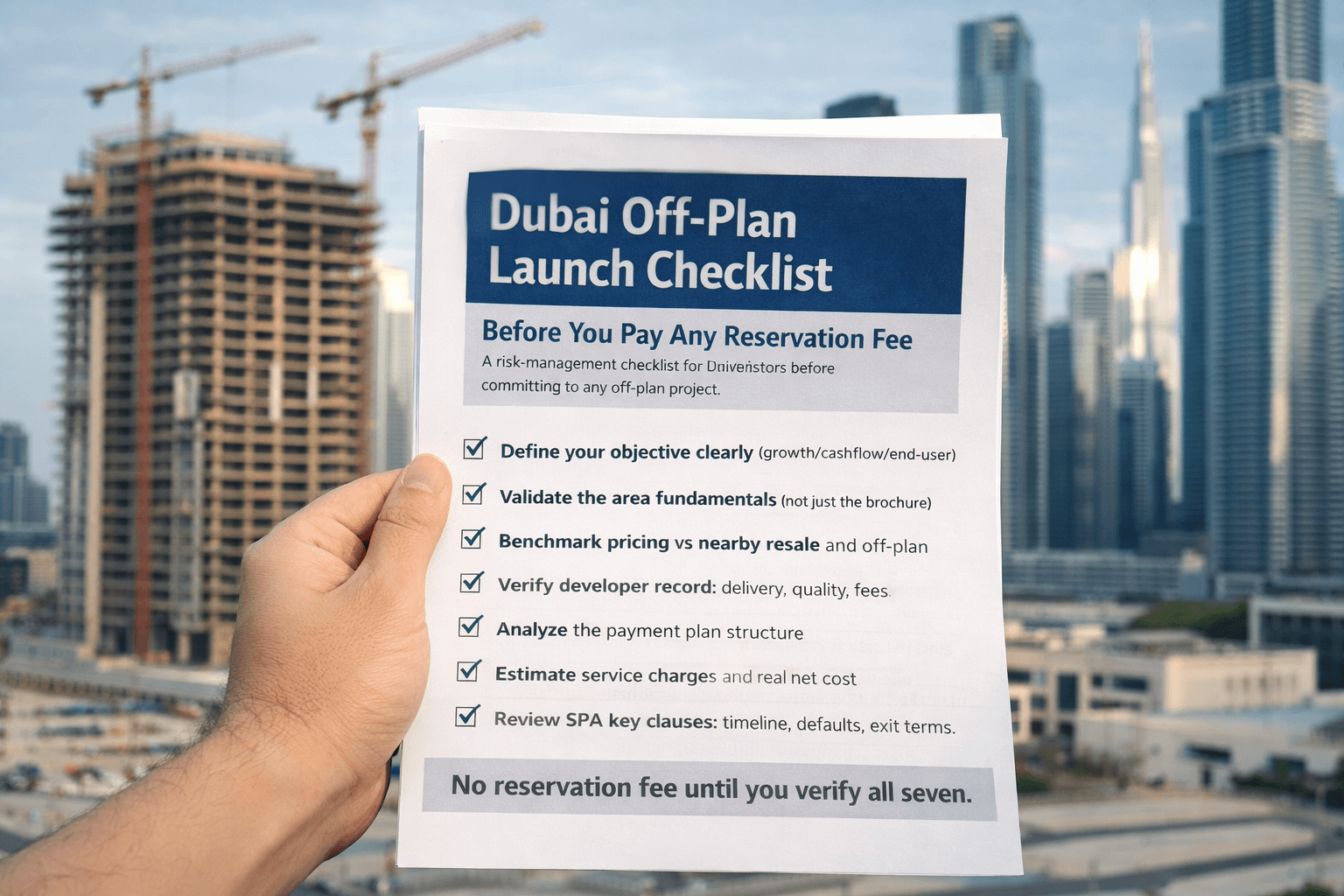
Off-plan launches in Dubai are designed to move fast. The marketing is polished, the urgency is real, and the reservation fee is positioned as a “small step.” In reality, that first payment is the moment most investors lose leverage—because once money is down, the decision becomes emotional.
- What a Reservation Fee Really Means
- The Dubai Off-Plan Launch Checklist (Step-by-Step)
- 1) Define one primary goal (cashflow, growth, or end-user)
- 2) Validate the area fundamentals (not the story)
- 3) Check supply risk (what’s being delivered nearby)
- 4) Benchmark pricing (launch price vs reality)
- 5) Treat the payment plan as a tool—not the investment
- 6) Identify every cost line (upfront + recurring)
- 7) Verify the developer’s delivery and quality track record
- 8) Confirm the unit type and layout are liquid (rent + resale)
- 9) Choose the right stack, not just the right project
- 10) Confirm what you are actually buying (specifications)
- 11) Align the rental strategy (long-term vs short-term)
- 12) Get key documents before you pay anything
- 13) Understand reservation terms (refundability and deadlines)
- 14) SPA clauses that matter most (must understand)
- 15) Stress-test the deal (simple worst-case math)
- The 60-Second “Reserve or Wait?” Decision
- Common Off-Plan Launch Traps (Avoid Them)
- Final Takeaway
- Want a Tailored Shortlist (3–5 Real Options)?
This article gives you a clear, practical checklist to follow before you pay any reservation fee, especially if you’re a non-resident buyer. Use it to validate fundamentals, pricing, liquidity, contract terms, and hidden costs—so you don’t end up with an illiquid unit sold on hype.
What a Reservation Fee Really Means
A reservation fee is not only administrative. It is a commitment trigger. After you pay, you’re more likely to rationalize problems instead of stepping back.
Trading Immo rule: If one key answer is unclear, do not reserve quickly—clarify first.
The Dubai Off-Plan Launch Checklist (Step-by-Step)
1) Define one primary goal (cashflow, growth, or end-user)
Before you look at any brochure, decide your main objective:
-
Cashflow: predictable rental income after handover
-
Growth: appreciation potential over 2–4 years
-
End-user: livability, community, long-term comfort
If you try to optimize for everything at once, you usually buy the wrong unit.
2) Validate the area fundamentals (not the story)
A strong developer can’t fix weak fundamentals. Ask:
-
Who is the future tenant/buyer here (professionals, families, tourists)?
-
What demand engine supports the area (employment hubs, schools, transport, lifestyle anchors)?
-
Is the area already proven, or is it “emerging” without real catalysts?
Red flag: “Next hot area” messaging without a clear reason people will live there and pay those rents.
3) Check supply risk (what’s being delivered nearby)
Off-plan performance is heavily impacted by what else delivers around the same time.
Check:
-
How many similar buildings are launching in the same community
-
What unit sizes are being produced (too many studios or 1BRs can pressure rents)
-
Delivery windows (if multiple projects hand over together, competition spikes)
Investor reality: A good unit in a crowded pipeline can still underperform.
4) Benchmark pricing (launch price vs reality)
Never pay a reservation fee without benchmarking the price.
Compare:
-
Price per sq.ft. vs similar projects in the same area
-
Resale prices in nearby comparable micro-markets
-
Current rent levels for similar units (to sanity-check future yields)
Red flag: Launch price is already above nearby resale reality, with no premium justification (view, scarcity, unique product, top-tier location).
5) Treat the payment plan as a tool—not the investment
A payment plan can improve cash management, but it does not create returns.
Before paying anything, understand:
-
Total % due before handover
-
Payment milestones (construction-linked vs date-linked)
-
Any balloon payments or “surprise” installments
-
Post-handover terms (and whether they are realistic)
Rule: If the deal only looks good because the payments feel easy, it’s not a strong investment.
6) Identify every cost line (upfront + recurring)
Most investor disappointment comes from “net reality” vs “headline ROI.”
Your model must include:
-
Government/registration-related costs (project structure matters)
-
Developer admin/processing fees
-
Broker/agency fees (if applicable)
-
Furnishing and setup (especially for short-term rental plans)
-
Vacancy buffer and maintenance reserve
-
Property management (often realistic for non-residents)
-
Annual service charges (critical)
Trading Immo rule: Always evaluate net numbers, not marketing yields.
7) Verify the developer’s delivery and quality track record
Do not rely on brand reputation alone. Validate the track record:
-
On-time delivery consistency (delays happen; frequency matters)
-
Build quality and finishing standards across past projects
-
Handover experience and snagging reputation
-
Community management quality (service charge governance matters)
Red flag: Heavy marketing presence but limited proven delivery in comparable product type.
8) Confirm the unit type and layout are liquid (rent + resale)
Liquidity matters more than small price differences.
Check:
-
Which unit type is most liquid in that area (studio vs 1BR vs 2BR)
-
Layout efficiency (usable living space, not wasted corridors)
-
Balcony practicality and livability
-
Natural light and orientation (comfort affects rental demand)
-
Resale appeal (would an end-user buy it later?)
Rule: Buy what rents fast and resells easily—even if it’s not the cheapest option.
9) Choose the right stack, not just the right project
Two units in the same tower can perform very differently.
Before reserving, review:
-
Tower plan and stack position
-
Exposure to road noise, construction views, service zones, generator areas
-
Proximity to elevators and garbage rooms (noise and foot traffic)
-
Floor selection logic (privacy, view quality, heat exposure)
Red flag: You are pressured to reserve without seeing the tower plan or without knowing the exact unit position.
10) Confirm what you are actually buying (specifications)
Words like “luxury” are meaningless unless specifications are explicit.
Verify in writing:
-
Finishing and materials (floors, kitchen, bathrooms)
-
Appliance inclusion/exclusion
-
Ceiling height (impacts perception and resale)
-
Smart home features (if claimed)
-
Parking allocation and rules
-
Furnished / semi-furnished / unfurnished handover status
11) Align the rental strategy (long-term vs short-term)
If you’re targeting short-term rental, treat it like a business, not passive income.
Confirm:
-
Area demand profile for short-term stays
-
Building/community rules (some restrict)
-
Setup costs (furnishing + photography + marketing)
-
Management capability (pricing, guest handling, maintenance)
Rule: For many non-residents, long-term rental is simpler and more predictable.
12) Get key documents before you pay anything
At minimum, ask for:
-
Reservation form (including refund conditions)
-
Payment plan schedule
-
Floor plan + tower/stack plan
-
Specification sheet (finishes and inclusions)
-
SPA summary or key terms (if full SPA is not yet provided)
Red flag: “Pay now, we’ll send paperwork later.”
13) Understand reservation terms (refundability and deadlines)
Before paying, clarify:
-
Is the reservation fee refundable or non-refundable?
-
Under what conditions can it be forfeited?
-
Timeline to sign the SPA after reservation
-
Any penalties for not proceeding
Rule: Never treat non-refundable money as “a small step.”
14) SPA clauses that matter most (must understand)
You do not need to be a lawyer to understand the risk points. Focus on:
-
Handover timeline definitions (what counts as delay?)
-
Penalty/compensation terms (if any)
-
Variation clauses (can the developer change layout/specs?)
-
Default and termination clauses
-
Payment obligations and consequences of late payment
If you can’t explain these in simple terms, do not reserve.
15) Stress-test the deal (simple worst-case math)
Run a basic stress test before committing:
-
Rent -10% vs your assumption
-
Vacancy +1–2 months/year
-
Service charges +15%
-
Handover delay 6–12 months
-
Setup costs higher than expected
If the deal becomes “bad” under mild stress, it was never strong.
The 60-Second “Reserve or Wait?” Decision
Reserve only if all of these are true:
-
Your goal is clear (cashflow/growth/end-user)
-
Pricing is benchmarked and reasonable
-
Unit type + layout are liquid (rent + resale)
-
Payment plan is fully understood (no surprises)
-
Developer delivery and quality are verified
-
All costs are modeled on a net basis
-
Reservation terms are clear (refundability and timelines)
-
You’ve reviewed the key documents
-
You have a simple exit plan
If even one item is unclear: wait.
Common Off-Plan Launch Traps (Avoid Them)
-
“Only today” urgency without allowing due diligence
-
Over-focusing on payment plan instead of fundamentals
-
Reserving without tower plan / stack clarity
-
Believing projected ROI without a net model
-
Choosing a unit type that is cheap but illiquid to resell
Dubai rewards disciplined investors. Speed is not a strategy.
Final Takeaway
Off-plan can be a strong growth tool, but only when you treat the launch like a structured decision:
Fundamentals → pricing → liquidity → costs → contract terms → stress test → exit plan.
If you follow this checklist, you’ll avoid most costly mistakes before they happen.
Want a Tailored Shortlist (3–5 Real Options)?
If you want a short, clear shortlist based on your budget and objective, request a tailored analysis. You’ll receive:
-
recommended strategy (off-plan vs ready)
-
2–3 area options aligned with your profile
-
unit-type guidance (liquidity + tenant demand)
-
the key risks to verify before committing
Request your analysis
