






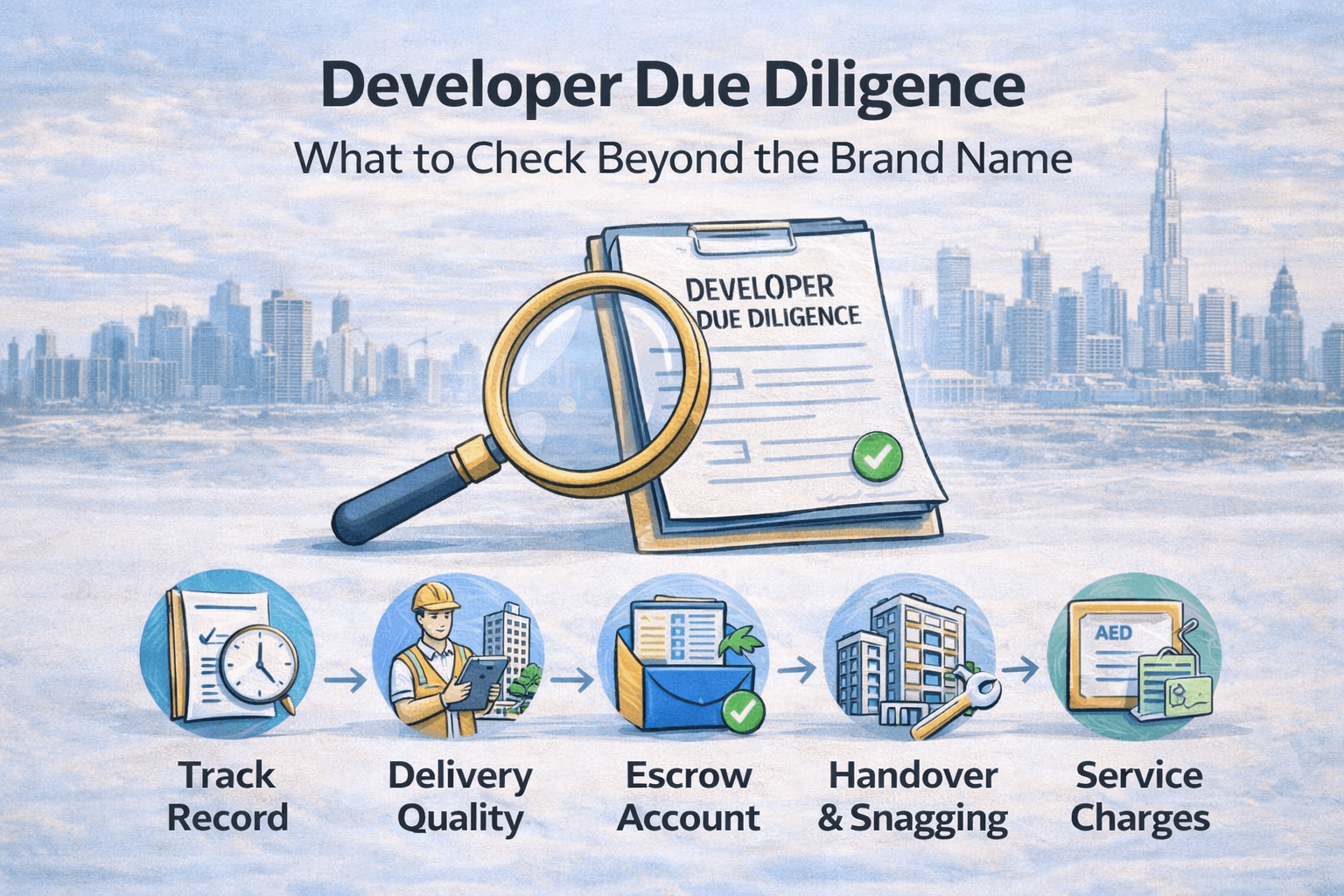
In Dubai off-plan, the developer name is often treated like a guarantee. It isn’t. A strong brand can reduce risk, but it cannot eliminate it. What you are really buying is a future product delivered on a future date—inside a building that will have real running costs, real management quality, and real tenant demand.
- The Trading Immo Rule
- What “Developer Risk” Really Means
- The Developer Due Diligence Checklist (What to Check)
- 1) Delivery Track Record (On-Time vs Delayed)
- 2) Quality Consistency (Not Just One Showcase Building)
- 3) Handover & Snagging Experience
- 4) Service Charges and Building Economics
- 5) Community / Facilities Management Quality
- 6) Product-Market Fit (Do They Build What Actually Rents?)
- 7) Pricing Discipline (Do They Sell at Premiums Everywhere?)
- 8) Contract & Transparency (SPA Clauses and Buyer Protections)
- 9) Escrow and Payment Security (Basic Hygiene)
- 10) Reputation Signal: Owners and Brokers (Reality Check)
- The “Minimum Due Diligence Pack” to Request
- The Three Biggest Mistakes Buyers Make
- A Simple Decision Filter (Fast)
- Final Takeaway
This is why developer due diligence matters. It helps you avoid the two expensive outcomes: buying into poor delivery quality, or buying into a building where service charges and management issues destroy net returns.
This guide gives you a clear investor checklist: what to verify beyond the logo, what documents to ask for, and the red flags that should stop you from reserving.
The Trading Immo Rule
Do not confuse marketing strength with operational excellence. You are not buying a brochure. You are buying a delivery process, construction quality, and long-term building economics.
What “Developer Risk” Really Means
When people say “developer risk,” they usually mean three categories:
-
Timeline risk: delays and handover uncertainty
-
Delivery risk: finishes, defects, build quality variance
-
Operational risk: building management quality, service charges, after-sales support
Most buyers focus only on the first two. Investors should care equally about the third.
The Developer Due Diligence Checklist (What to Check)
1) Delivery Track Record (On-Time vs Delayed)
Don’t ask, “Have you delivered projects?” Ask:
-
How often did projects deliver on time?
-
How long were the delays when they occurred?
-
Were delays concentrated in certain periods or project types?
-
Do they deliver consistently in the same category you are buying (mid-market, luxury, villas, waterfront)?
Why it matters: A 6–12 month delay changes your entire ROI timeline, opportunity cost, and liquidity plan.
Red flags:
-
Vague answers (“usually on time”) without evidence
-
No comparable delivered projects to evaluate
2) Quality Consistency (Not Just One Showcase Building)
Most developers have a “hero project” that looks exceptional. Your question is consistency:
-
Do multiple past projects show similar finishing standards?
-
Are common areas maintained well after delivery?
-
Do owners complain about recurring defects?
What to look at in real life:
-
Lobby, elevators, corridors (finish quality shows quickly)
-
Bathroom and kitchen finishing details
-
Window quality and sound insulation perception
-
Maintenance level 2–5 years after handover
Red flags:
-
Beautiful marketing renders, but older delivered projects feel worn or poorly maintained
-
Frequent owner complaints about leaks, AC issues, or poor finishing
3) Handover & Snagging Experience
A “handover” is not just keys. It’s the moment defects are discovered and resolved (or not).
Ask:
-
How responsive is the developer during snagging?
-
What is the typical defect resolution timeline?
-
Is there a structured after-sales system or a “disappear after handover” reputation?
Why it matters: Snagging issues slow down rental setup, impact tenant perception, and create extra cost.
Red flags:
-
Owners report long delays in defect fixes
-
No clear after-sales process
4) Service Charges and Building Economics
For investors, service charges can be the difference between “good gross ROI” and “bad net ROI.”
Check:
-
Are service charges historically high in the developer’s buildings?
-
Are they aligned with the rent level in that area?
-
Are there recurring “special charges” or unpredictable maintenance items?
Important: High service charges aren’t automatically bad if the building is premium and rents justify it. But you must validate the rent-to-charges relationship.
Red flags:
-
High charges in a mid-market building with average rents
-
Lack of transparency on expected service charge range
5) Community / Facilities Management Quality
Developer quality and building management quality are not the same. The operational phase is driven by:
-
facilities management (FM)
-
maintenance standards
-
cleanliness, security, and resident experience
-
response time to issues
If the building is poorly managed, tenants churn faster and resale becomes harder.
Red flags:
-
Complaints about elevators, AC, water issues, or security problems
-
Poor maintenance in delivered buildings
6) Product-Market Fit (Do They Build What Actually Rents?)
A developer can deliver quality but still create weak investments if the product is misaligned with demand.
Check:
-
Are unit layouts livable (not just “small BUA to look cheap”)?
-
Are the unit types aligned with tenant demand in that area?
-
Are they overproducing the same segment (e.g., too many studios)?
Red flags:
-
Unusual layouts that reduce livability
-
Oversupply risk in that unit type and community
7) Pricing Discipline (Do They Sell at Premiums Everywhere?)
Some developers systematically price at a premium. Sometimes it’s justified. Sometimes it isn’t.
Benchmark:
-
price per sq.ft. versus comparable resale and nearby launches
-
premium justification (view, scarcity, quality, location)
-
resale liquidity of previous phases (do units resell easily?)
Red flags:
-
Premium pricing justified only by “brand”
-
Launch prices above resale reality without strong rationale
8) Contract & Transparency (SPA Clauses and Buyer Protections)
Your SPA is where risk becomes real. Review:
-
handover timeline definitions (what counts as delay?)
-
variation clauses (can layout/spec change?)
-
default clauses and penalties
-
cancellation terms and developer rights
-
payment plan triggers (milestone vs date-based clarity)
Red flags:
-
Vague milestone definitions
-
Strong developer flexibility with weak buyer protections
-
Pressure to sign without time to review
9) Escrow and Payment Security (Basic Hygiene)
Off-plan payments are typically linked to regulated structures and escrow mechanisms. As a buyer, you should still confirm:
-
project registration and official documentation availability
-
clarity on payment routing and receipts
-
legitimate developer communication channels
Red flags:
-
Requests to pay to unclear accounts or non-standard channels
-
Missing official paperwork
10) Reputation Signal: Owners and Brokers (Reality Check)
The fastest truth is often found in:
-
owners’ feedback on delivered projects
-
brokers who manage rentals and resales in that building
-
property managers who handle tenant issues
Ask simple questions:
-
Does it rent fast?
-
Are tenants happy?
-
Are service charges painful?
-
Are there recurring defects?
Red flags:
-
Consistent negative patterns across multiple sources
The “Minimum Due Diligence Pack” to Request
Before reserving, ask for:
-
unit details: tower, floor, stack, BUA, specs
-
payment plan schedule
-
fee breakdown (DLD/admin/Oqood-related items)
-
SPA summary or full SPA draft (if available)
-
delivery timeline with clarity on milestones
-
any service charge guidance (or comparable building references)
If they can’t provide clarity, don’t proceed on speed.
The Three Biggest Mistakes Buyers Make
-
Buying the brand instead of the building economics (service charges, management, livability)
-
Evaluating only the brochure and showroom, not delivered buildings
-
Reserving before benchmarking price and liquidity versus real comps
A Simple Decision Filter (Fast)
Consider the developer “investment-grade” for your deal only if:
-
delivered projects show consistent quality and maintenance
-
handover and snagging reputation is solid
-
service charges are reasonable versus rent in that micro-market
-
pricing premium (if any) is justified versus comps
-
SPA risk clauses are understood and acceptable
If two or more elements are unclear, pause. In Dubai off-plan, clarity is protection.
Final Takeaway
A developer name is not a guarantee. What matters is delivery performance, quality consistency, and long-term building economics. If you check only the brand, you are buying marketing. If you check the track record, maintenance reality, service charges, and SPA clauses, you are buying an investment.


