






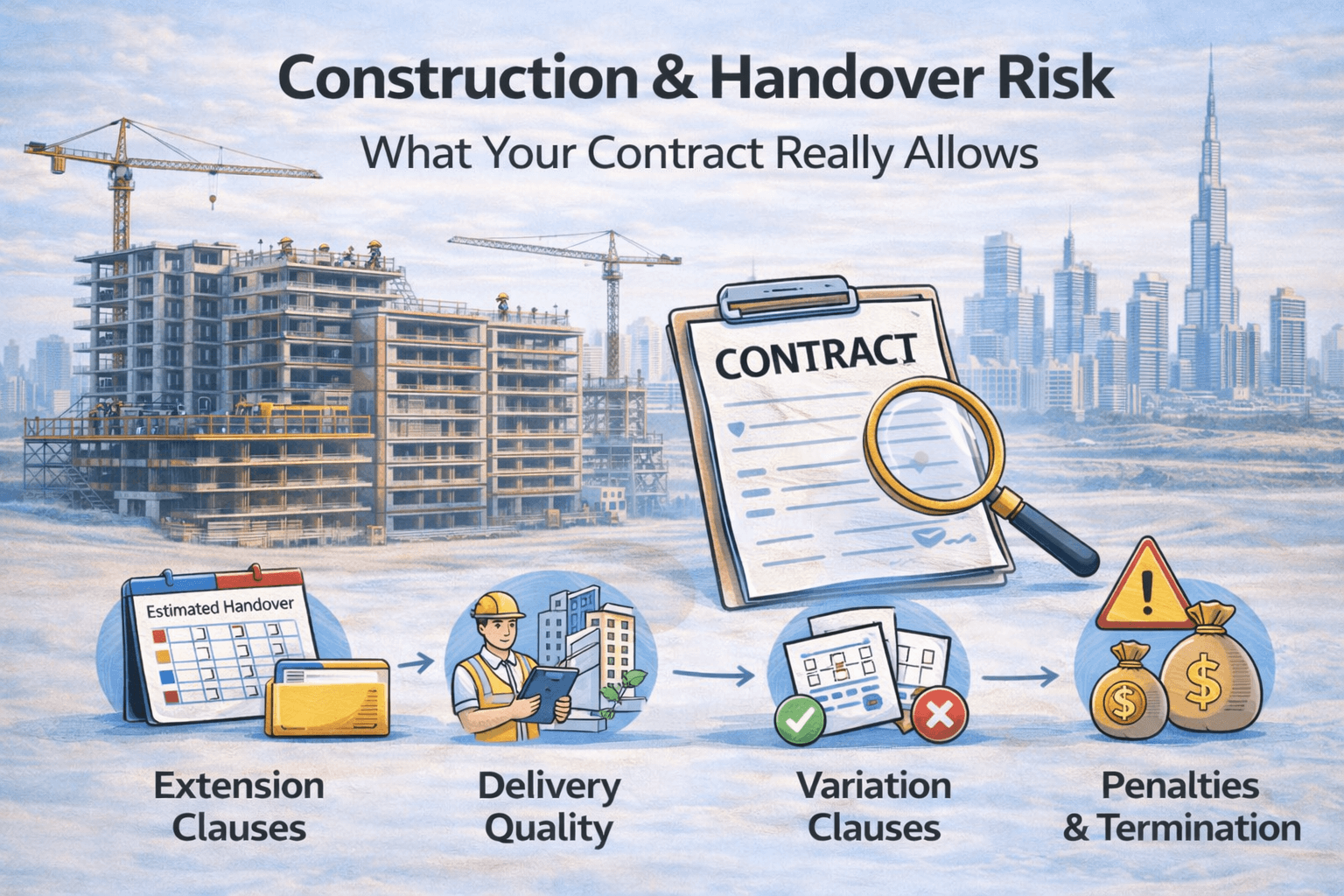
In Dubai off-plan, most investors worry about the market. The bigger risk is often simpler: the project doesn’t deliver on the timeline you expected, the finished product differs from what you imagined, or the handover process delays your rental income. And the hard truth is this: in most cases, what happens next is determined by your contract—your SPA (Sales and Purchase Agreement).
- The Trading Immo Rule
- What “Construction Risk” Really Includes
- The Off-Plan Timeline (Where Risk Shows Up)
- The SPA Clauses That Matter Most (Investor Checklist)
- 1) The Handover Date: Is It a Date or a Range?
- 2) Extension and Delay Clauses: How Much Flexibility Does the Developer Have?
- 3) Compensation / Penalty Clauses: Do You Get Anything If Delivery Is Late?
- 4) Variation Clauses: Can They Change the Layout or Specs?
- 5) Milestone vs Date-Based Payment Triggers: What If Construction Progress Doesn’t Match Payments?
- 6) Default and Termination: What Happens If You Miss a Payment?
- 7) Assignment / Resale Before Handover: Are You Allowed to Exit?
- 8) Handover Conditions: What Must Happen Before They “Hand Over”?
- 9) Title Deed Timing: How Quickly Do You Get Final Ownership?
- The Real Costs of Handover Delays (What Investors Underestimate)
- How to Protect Yourself (Practical, Non-Legal)
- The “Delay Stress Test” (Simple)
- Final Takeaway
This article explains construction and handover risk in plain English. You’ll learn what the SPA typically allows (and what it doesn’t), which clauses matter most, what to look for before you sign, and how to protect your strategy if timelines move.
This is not legal advice. It’s a practical investor framework to help you ask the right questions before you commit.
The Trading Immo Rule
Off-plan is not risky because construction exists. It’s risky because buyers assume the contract protects them more than it actually does. Your job is not to “hope delivery is on time.” Your job is to understand your rights, your obligations, and the developer’s flexibility.
What “Construction Risk” Really Includes
Construction and handover risk is not one thing. It’s a cluster of risks that impact your returns:
-
Timeline risk: handover delays shift your ROI timeline and lock capital longer
-
Delivery risk: quality and specifications at handover can differ from expectations
-
Cashflow risk: you may start paying service charges and utilities while rental income is delayed
-
Exit risk: resale liquidity can be weaker if the market cools by the time the project delivers
Your SPA defines what happens under each scenario.
The Off-Plan Timeline (Where Risk Shows Up)
The typical off-plan lifecycle looks like this:
Reservation → SPA signing → Construction installments → Completion notice → Snagging/inspection → Handover → Title deed issuance.
Construction and handover risk sits in the middle: the gap between “what you were sold” and “what is delivered,” plus the time it takes to move from handover to actual usable property.
The SPA Clauses That Matter Most (Investor Checklist)
1) The Handover Date: Is It a Date or a Range?
Many buyers think they’re buying a fixed delivery date. In reality, SPAs often define:
-
an estimated completion date, not guaranteed
-
a notice period window
-
and sometimes an extension period the developer can use
What to look for:
-
Is the handover date “estimated” or “fixed”?
-
Is there an explicit extension period? How long?
-
What triggers “completion”—practical completion, final completion, or another definition?
Investor reality: if you underwrite your deal on a specific month, but the contract allows a wide range, your underwriting is fragile.
2) Extension and Delay Clauses: How Much Flexibility Does the Developer Have?
This is where many buyers get surprised. Contracts often allow the developer to extend timelines under broad conditions. Some of these conditions are normal. Some are written very widely.
What to look for:
-
How is a delay defined?
-
What reasons are allowed (force majeure, regulatory, supply chain, etc.)?
-
Does the developer need to prove delay, or can they declare it?
-
What is your recourse if delays occur?
Red flag: broad delay clauses with no meaningful buyer protections.
3) Compensation / Penalty Clauses: Do You Get Anything If Delivery Is Late?
Some buyers assume “late delivery equals compensation.” Often, that’s not how it works.
Check:
-
Is there a penalty or compensation clause?
-
When does it start? Only after an extension period?
-
Is compensation capped?
-
Is it credited against future payments rather than paid to you?
Red flag: no compensation mechanism at all, or compensation that only activates after a long extension window.
4) Variation Clauses: Can They Change the Layout or Specs?
Most SPAs contain variation clauses that allow changes to:
-
unit layout within tolerance
-
materials and finishes
-
building plans, amenities, or common areas
Not all variations are bad. Construction realities exist. The issue is how wide the permitted changes are.
What to look for:
-
What exactly can be changed?
-
Is there a “material change” definition?
-
Do you have the right to cancel if changes are significant?
-
Do they owe compensation for changes?
Red flag: variation clauses that allow major changes without buyer consent or remedy.
5) Milestone vs Date-Based Payment Triggers: What If Construction Progress Doesn’t Match Payments?
If payments are date-based, you can be forced to pay regardless of progress. If milestone-based, you need clear milestone definitions.
What to look for:
-
milestone definitions and evidence requirements
-
what happens if milestones are disputed
-
whether the developer can modify the payment schedule
Red flag: vague milestones, or an aggressively front-loaded schedule that increases your capital exposure early.
6) Default and Termination: What Happens If You Miss a Payment?
Buyers focus on developer obligations, but your obligations matter too.
Check:
-
grace periods for late payments
-
penalty/interest terms
-
developer termination rights
-
refund structure if your contract is terminated
Red flag: termination clauses that allow fast termination with heavy forfeiture, especially if you are relying on rental cashflow later.
7) Assignment / Resale Before Handover: Are You Allowed to Exit?
Some investors plan to resell before completion. But your ability to assign can depend on:
-
whether assignment is permitted
-
fees payable to the developer
-
how much you must pay before assignment is allowed (e.g., 30–40%)
-
administrative approvals and timelines
Red flag: assignment is technically allowed but practically blocked by high thresholds or unclear approvals.
8) Handover Conditions: What Must Happen Before They “Hand Over”?
Handover is not always “the building is perfect.” It can be linked to definitions such as:
-
practical completion
-
obtaining certain certificates
-
the developer declaring readiness
What to look for:
-
what defines handover readiness
-
what defects are acceptable at handover (snagging scope)
-
how snagging is documented and resolved
-
timelines for defect fixing
Red flag: unclear snagging process or no obligation to fix defects within a defined timeframe.
9) Title Deed Timing: How Quickly Do You Get Final Ownership?
Oqood is interim off-plan registration. Title deed comes after completion and final transfer. Confirm:
-
when title deed is expected after handover
-
whether any conditions delay title deed issuance
-
what documentation you must provide
This matters for refinancing, resale, and formal ownership processes.
The Real Costs of Handover Delays (What Investors Underestimate)
A delay is not just “waiting longer.” It can create tangible costs:
-
delayed rental income (opportunity cost)
-
additional months of capital locked in a non-producing asset
-
market cycle risk (handover into a slower market)
-
potential additional setup costs or re-pricing for rentals
And after handover, you may start paying service charges before you have a tenant.
How to Protect Yourself (Practical, Non-Legal)
Before signing, do these five actions:
-
Request a plain-English summary of handover and delay clauses
-
Benchmark developer delivery history (how often delays occur)
-
Model a delay scenario (6–12 months) in your investment math
-
Avoid deals that only work if handover is perfectly on time
-
Do not reserve if key contract terms are not available to review
Trading Immo rule: if you need perfect conditions for the deal to work, it’s not a plan—it’s a gamble.
The “Delay Stress Test” (Simple)
Before you commit, answer:
-
Can I afford 6–12 months delay without pressure?
-
Does my strategy still make sense if rent starts later?
-
Do I have buffers for snagging, setup, and vacancy?
-
Is my exit plan still credible if the market cools at handover?
If your answer is no, you’re buying too close to your liquidity limit.
Final Takeaway
Construction and handover risk is real, but it’s manageable when you read your contract like an investor. The SPA often gives the developer flexibility on timelines and variations, and your protections depend on the exact wording. The right move is not to avoid off-plan. The right move is to understand what your SPA allows, model delays realistically, and buy only when fundamentals, liquidity, and pricing still work under stress.


