






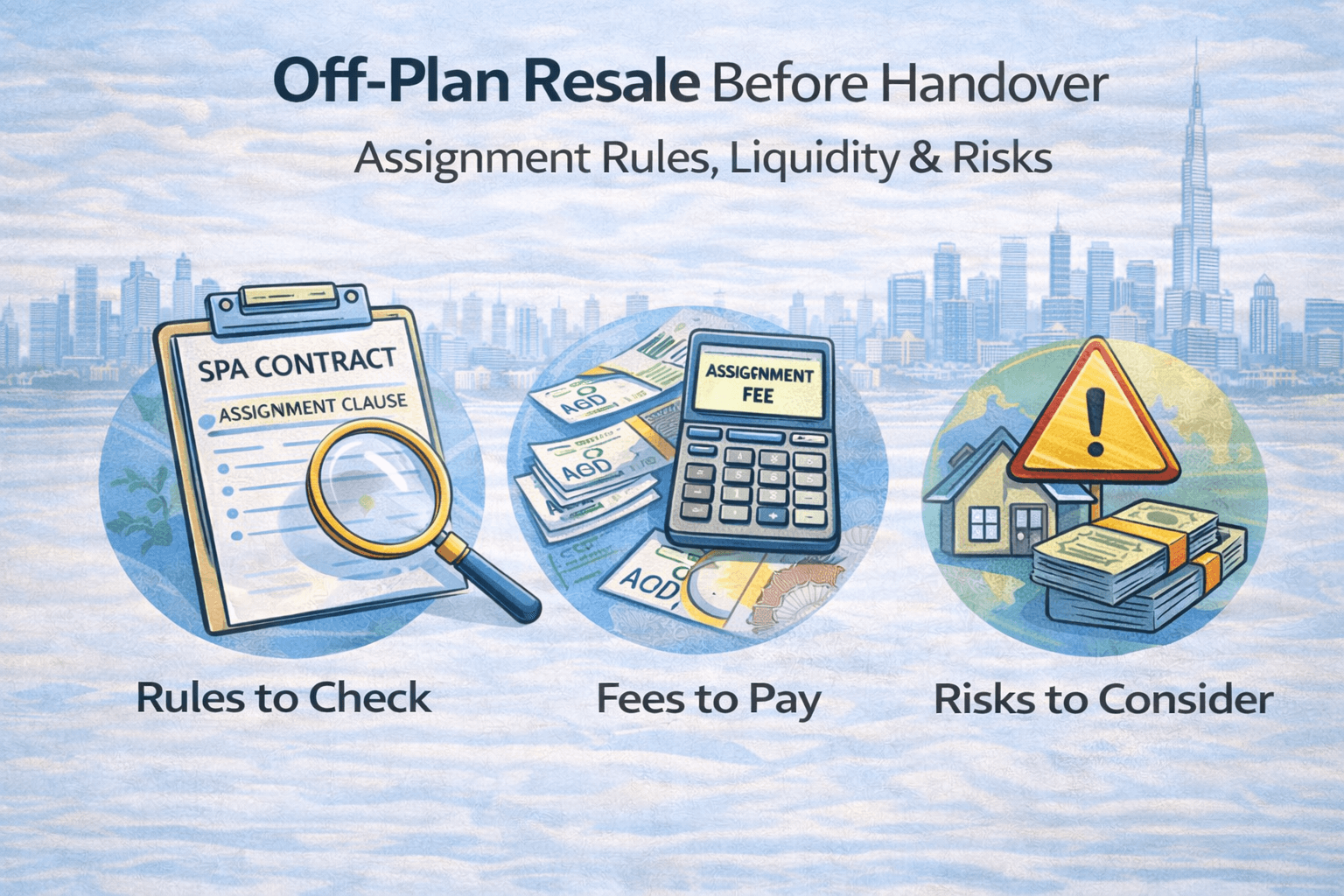
This article explains the assignment process simply: what it is, how it works, what developers usually require, what fees apply, when it can make sense, and the risks that can turn a planned exit into a costly problem.
Quick Definitions (So You Don’t Get Misled)
Assignment (off-plan resale before handover): selling your off-plan contract to a new buyer before the unit is completed and before title deed issuance. The buyer takes over your SPA obligations and remaining payments.
Important: Assignment is not the same as selling a title deed property. You are transferring a contract position, not a completed registered title.
The Trading Immo Rule
If your strategy requires a fast resale in a slow market, it’s not a strategy—it’s a gamble. Assignment only works when liquidity exists and pricing is not inflated.
Can You Always Resell Before Handover?
No. Whether you can assign depends on the developer’s policy for that project, the assignment clause in your SPA, any payment thresholds you must meet, and administrative approvals and timing. Some projects allow it early; others restrict it heavily. Never assume. Verify in writing.
How Assignment Usually Works (Simple Step-by-Step)
While details vary, the flow is typically: you confirm assignment eligibility under the SPA and developer rules, you meet the minimum paid threshold (if required), you find a buyer willing to take over your contract, both parties submit documents to the developer, assignment fees are paid (often by seller or negotiated), the developer issues approval and updates the contract under the new buyer, and the remaining payment plan continues under the buyer until handover.
In many cases, the developer must approve the new buyer. This adds friction—and friction impacts liquidity.
The 7 Assignment Rules You Must Check (Before You Buy, Not Later)
If you’re considering an off-plan purchase with a potential pre-handover exit, clarify these points before reserving.
1) Is assignment allowed at all?
Some SPAs allow assignment only after certain conditions; others make it practically impossible.
2) What % must be paid before assignment is permitted?
Many developers require a minimum percentage paid before you can resell. If you planned to exit early but must pay a large % first, your capital is locked and your flexibility is lower than you think.
3) What are the assignment fees (and who pays)?
Common structures include a fixed admin fee, a percentage-based fee, and other processing costs. You must know the fee schedule in advance because fees can erase your margin.
4) Does the developer require NOC/approval? What is the timeline?
If approval takes weeks, liquidity drops and buyer appetite weakens—especially in slower markets.
5) Can the developer restrict pricing or set conditions?
Some developers apply conditions that limit how the transfer occurs. Even without explicit price controls, administrative friction can function like a restriction.
6) Can you assign if you are late on payments?
Usually no. Your exit option often depends on strict payment discipline.
7) Are there restrictions close to handover?
Some projects tighten transfer rules as handover approaches. Confirm whether there is a cut-off period.
Liquidity Reality: The Part Nobody Markets
Assignment success depends less on the rulebook and more on liquidity: is there real buyer demand at your price level, are there many similar assignments competing, is the project saturated with listings, and are buyers choosing newer launches with better incentives? In a hot market, assignment feels easy. In a normal market, it becomes competitive. In a slow market, many flippers get trapped.
Trading Immo rule: You don’t profit from “being early.” You profit from having an asset that other buyers want at your price.
When Assignment Can Make Sense (Realistic Use Cases)
1) You bought at a truly strong entry price
Not launch hype—an entry price that stays competitive versus later phases, nearby competing launches, and resale reality in substitute areas.
2) The project has strong end-user appeal
End-user demand supports resale liquidity. If only investors buy it, resale can become crowded.
3) Your unit has a superior micro-position
Stack, view, floor, layout, and orientation matter. Average units struggle first when markets cool.
4) Supply is controlled (not oversupplied)
If dozens of identical units are being assigned at the same time, your bargaining power collapses.
5) Your exit is optional, not necessary
The best position is being able to resell if conditions are strong, but also to hold through handover if liquidity is weak.
The Biggest Risks of Reselling Before Handover
Risk 1: You discover assignment is restricted or delayed
If assignment requires high thresholds or long approval cycles, you may miss your exit window.
Risk 2: Fees destroy your profit margin
Assignment fees, admin costs, and broker fees can wipe out paper gains.
Risk 3: Liquidity disappears when the market shifts
If the market slows, buyers negotiate harder and your resale timeframe expands. You may be forced to discount or hold longer than planned.
Risk 4: Competing launches offer better incentives
Buyers compare your assignment to brand-new launches with flexible payment plans and waived fees, which can pressure your resale price.
Risk 5: Payment deadlines force you into bad decisions
You may need to keep paying installments while trying to sell. Cash pressure can force you to accept a low offer.
The “Assignment Math” You Must Do (Simple and Brutal)
Before planning an assignment exit, calculate your total paid to date (capital at risk), remaining payments due soon (cash pressure), assignment fee and admin costs, broker fees, and your realistic sale price under conservative conditions. If your profit exists only in best-case pricing, your assignment plan is fragile.
Practical Checklist Before You Reserve (If You Want Assignment Flexibility)
Ask for these in writing: SPA assignment clause (exact wording), minimum paid threshold required, assignment fee schedule, approval/NOC requirements and timeline, any restrictions or cut-off periods, and confirmation of the process steps and documents required. If they won’t clarify, assume assignment will be difficult.
Final Takeaway
Off-plan resale before handover can work, but it’s not guaranteed—and it’s rarely as easy as marketing suggests. Assignment is a contract transfer that depends on developer rules, fees, and real market liquidity. The safest approach is to buy an off-plan unit that works even if you cannot resell early—then treat assignment as an upside option, not a necessity.


