






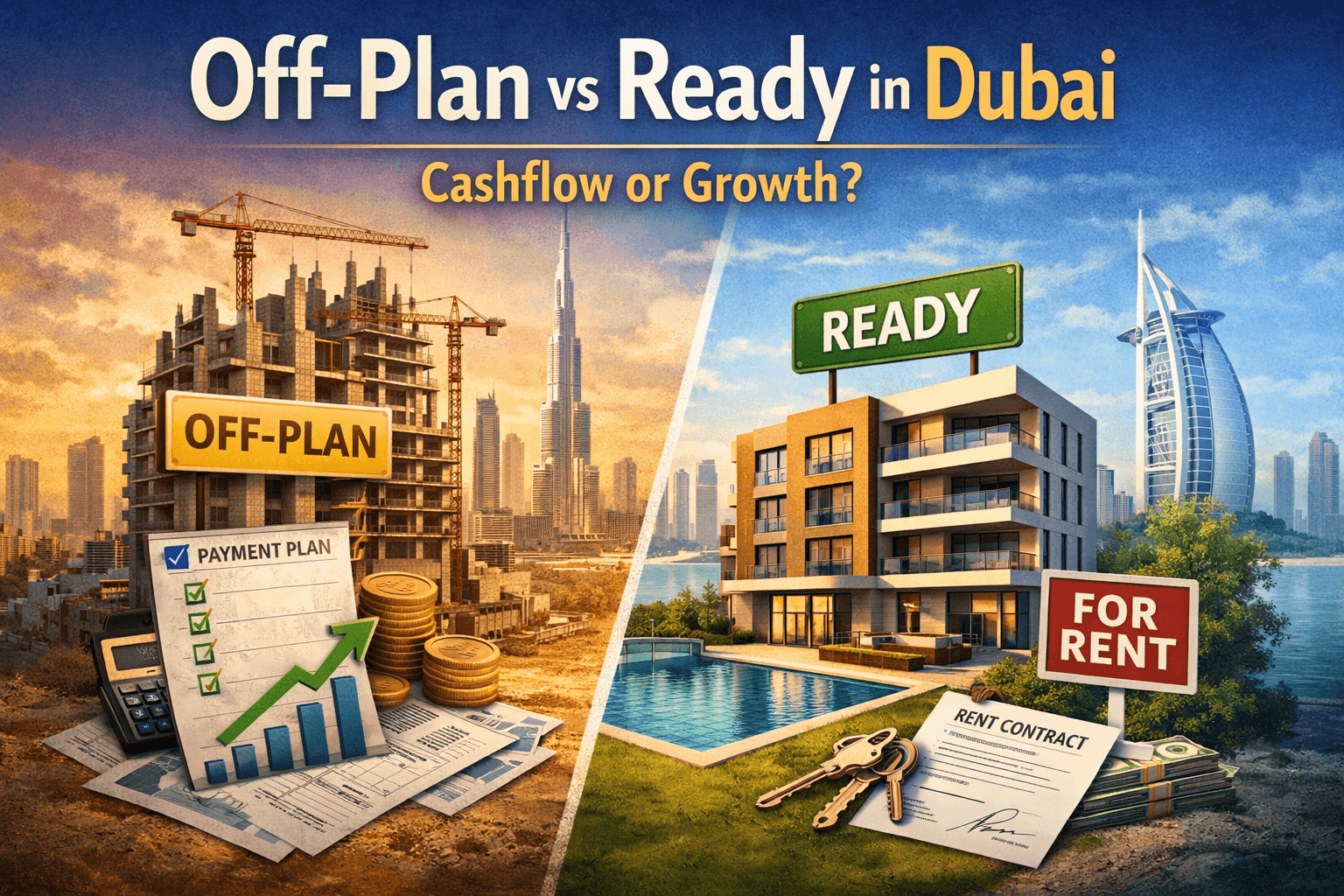
Dubai real estate can move fast, feel complex, and sound heavily promotional—especially when you’re buying from abroad. The biggest mistake most non-resident buyers make is not “overpaying at the last step,” but choosing the wrong strategy at the first step.
- What “Ready” and “Off-Plan” Really Mean
- The Trading Immo Rule: Match the Product to the Objective
- If Your Goal Is Cashflow: Ready Property Is the Default
- If Your Goal Is Growth: Off-Plan Can Work (Selectively)
- The Real Trade-Offs: Off-Plan vs Ready
- The 5 Filters That Decide Correctly (Trading Immo Framework)
- 1) Goal clarity (cashflow vs growth)
- 2) Net numbers only
- 3) Liquidity (rent + resale)
- 4) Risk (timeline + delivery + market cycle)
- 5) Exit plan
- Practical Scenarios: Choose in 30 Seconds
- Scenario A: You want stable income within 3–6 months
- Scenario B: You have a 2–4 year horizon and want appreciation
- Scenario C: You’re unsure and buying from abroad
- Scenario D: You want short-term rental (Airbnb style)
- The Most Common Mistakes (And How to Avoid Them)
- Mistake 1: Choosing off-plan because the payment plan is “easy”
- Mistake 2: Ignoring service charges
- Mistake 3: Buying the wrong unit type
- Mistake 4: Comparing too many options
- Mistake 5: Reserving before clarifying the basics
- 2-Minute Checklist: Off-Plan or Ready?
- Final Takeaway
- Want a Tailored Shortlist for Your Budget?
Before you compare projects, payment plans, or “ROI” claims, make one decision:
Are you buying for cashflow (income) or for growth (appreciation)?
That choice will usually tell you whether ready property or off-plan fits you best.
What “Ready” and “Off-Plan” Really Mean
Ready property (secondary market)
A completed unit you can buy today and rent out (or move into) immediately. You can validate real rents, real service charges, and real building quality.
Off-plan property (new launch / under construction)
A unit sold during construction, typically with staged payments until handover. It can offer flexibility and upside—but adds timeline risk and delivery risk.
The Trading Immo Rule: Match the Product to the Objective
Trying to optimize for everything (high yield + high growth + perfect lifestyle + “easy payment plan”) usually leads to the worst outcome: the wrong unit in the wrong place.
Instead, choose one primary objective:
-
Cashflow investor: predictable income and stable demand
-
Growth investor: appreciation potential and future resale liquidity
-
End-user buyer: livability, community, and long-term comfort
This article focuses on the two most common investor profiles: cashflow vs growth.
If Your Goal Is Cashflow: Ready Property Is the Default
Cashflow investing is not about “headline ROI.” It’s about net income after all costs and the ability to keep the unit rented without stress.
Why ready property fits cashflow
Ready property typically performs better for cashflow because you can verify:
-
Actual rental demand (not assumptions)
-
Real rent levels (through comparable listings and recent contracts where possible)
-
Service charges (often the biggest silent threat to net yield)
-
Building condition and management quality
-
Rental liquidity (how fast units rent at a fair price)
In other words: ready property gives you clarity.
The cashflow investor’s priority list
If you’re a cashflow buyer, your top questions should be:
-
How quickly will this unit rent at a realistic price?
-
What are the annual service charges and running costs?
-
What is the net yield, not the gross yield?
-
Is this unit type easy to resell if you need an exit?
If you can’t answer #2 and #3 confidently, you are not evaluating cashflow—you’re evaluating marketing.
If Your Goal Is Growth: Off-Plan Can Work (Selectively)
Growth investing is about buying something that will be more desirable later—without relying on hype. You are effectively making a controlled bet on future demand + liquidity.
Why off-plan can fit growth
Off-plan can make sense for growth because:
-
You often enter earlier than the end-user market
-
The product is new at handover (which can attract tenants and buyers)
-
Payment plans can improve capital efficiency (how you deploy your cash)
But here is the non-negotiable point:
Payment plans are not returns. They are cash-flow structure.
A weak location with poor fundamentals is still a weak investment, even with a flexible plan.
The growth investor’s priority list
If you’re a growth buyer, your top questions should be:
-
What will drive demand in this area at handover (not today)?
-
Will the unit be liquid on resale in a slower market?
-
Is pricing reasonable compared to current and nearby comparables?
-
Is the developer consistent on delivery and quality?
-
Do I have a clear exit plan (hold, resell after handover, refinance)?
Growth only works when your asset has future buyers—not just “launch excitement.”
The Real Trade-Offs: Off-Plan vs Ready
Ready property: the strengths
Ready is best if you want:
-
Immediate rental income
-
Less uncertainty
-
Visible rent comps and operating costs
-
A faster learning curve (you see performance quickly)
Typical trade-off:
-
Less “payment plan leverage”
-
More upfront capital required
-
You must do serious due diligence on building management and service charges
Off-plan: the strengths
Off-plan is best if you want:
-
Payment plan flexibility
-
A longer-term growth hold into handover
-
Newer building stock and modern product later
-
Potential uplift during construction (in the right cycle)
Typical trade-off:
-
Timeline risk (handover delays happen)
-
Delivery risk (quality can vary)
-
Market cycle risk (conditions may change by completion)
-
No cashflow until handover + leasing
The 5 Filters That Decide Correctly (Trading Immo Framework)
If you apply only five filters, apply these.
1) Goal clarity (cashflow vs growth)
If your objective isn’t crystal clear, every “deal” can look attractive—and you’ll overpay.
2) Net numbers only
Always model net returns with:
-
service charges
-
vacancy assumptions
-
maintenance reserve
-
property management (common for non-residents)
-
furnishing/setup costs (especially for short-term rentals)
Investor rule: never buy based on gross yield alone.
3) Liquidity (rent + resale)
Two questions:
-
Can it rent quickly at a fair market price?
-
Can it resell easily if the market slows?
Liquidity is the difference between an investment and a trap.
4) Risk (timeline + delivery + market cycle)
Ready property reduces uncertainty.
Off-plan adds layers of risk you must be paid to take.
5) Exit plan
Define one exit in advance:
-
hold long-term for income
-
resell after handover
-
refinance later
-
resell before handover (only if rules and liquidity support it)
If you cannot state your exit plan in one sentence, you are not ready to reserve.
Practical Scenarios: Choose in 30 Seconds
Scenario A: You want stable income within 3–6 months
Default choice: Ready property.
Why: immediate rent and real numbers.
Scenario B: You have a 2–4 year horizon and want appreciation
Default choice: Off-plan (selectively).
Why: growth aligns with time, but only with strong fundamentals.
Scenario C: You’re unsure and buying from abroad
Default choice: Ready first, off-plan later.
Why: ready gives you clarity and teaches you the market quickly.
Scenario D: You want short-term rental (Airbnb style)
Default choice: Usually ready.
Short-term rental is an operating business (furnishing, pricing, marketing, management). Ready lets you validate demand and costs faster.
The Most Common Mistakes (And How to Avoid Them)
Mistake 1: Choosing off-plan because the payment plan is “easy”
A payment plan is not investment quality. Validate fundamentals first.
Mistake 2: Ignoring service charges
High service charges can destroy net yield even when rent looks strong.
Mistake 3: Buying the wrong unit type
In many areas, liquidity matters more than a small difference in purchase price. Prioritize units that rent and resell quickly.
Mistake 4: Comparing too many options
Shortlist 3–5 realistic options and go deep. Comparing 20 projects leads to confusion and emotional decisions.
Mistake 5: Reserving before clarifying the basics
If goal, costs, liquidity, and exit are unclear—pause. Clarify first.
2-Minute Checklist: Off-Plan or Ready?
Answer these quickly:
-
What is my primary goal: cashflow or growth?
-
Do I need rental income within the next 3–6 months?
-
What are the service charges and realistic operating costs?
-
What is the net yield after vacancy, management, and maintenance?
-
How strong is rental liquidity in this area for my unit type?
-
How strong is resale liquidity if the market slows?
-
If off-plan: do I understand the payment plan and handover timeline?
-
What is my exit plan if conditions change?
If you cannot answer #3, #4, or #8, don’t reserve anything yet.
Final Takeaway
-
Ready property is the best default for cashflow clarity and reduced uncertainty.
-
Off-plan can be powerful for growth, but only when you have strong fundamentals, realistic pricing, and a clear exit plan.
Dubai rewards disciplined investors. The winners are not the ones who move fastest—they are the ones who evaluate correctly.
Want a Tailored Shortlist for Your Budget?
If you want a clear shortlist (3–5 options) aligned with your goal, you can request a tailored analysis. You’ll receive:
-
a recommended strategy (off-plan vs ready)
-
2–3 area options matching your tenant profile and exit plan
-
unit-type guidance (liquidity + demand)
-
the key risks to verify before you commit


